Geometry: Shape Before Colour
How to read compound tank curves, frame downtubes, and mudguard crowns so geometric patterns stay straight in three dimensions.
Reading the Three Structural Planes of a Fuel Tank
A motorcycle fuel tank is rarely a simple cylinder or box; it is a compound sculpture that tapers in both plan view and elevation view. Whether you are working with a teardrop steel pressing from a 1970s twin, a slab-sided endurance alloy cell, or a multi-piece modern sportbike cover, almost every tank divides into three distinct visual planes: the top crown, the shoulder roll, and the knee flank.
When riders sketch a paint scheme on a flat two-dimensional side profile, straight diagonal lines often look crisp on paper. Yet the moment you stretch masking tape across the physical tank, a line that starts on the vertical knee flank and climbs over the shoulder roll curves sharply toward the rider's chest. To make a geometric block appear straight from a standing side view, the actual tape path on the metal must curve slightly forward as it climbs over the fuller front half of the tank.
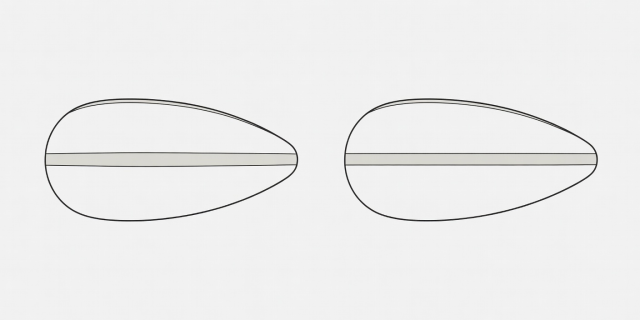
Compound Curve Compensation
View the line from a consistent eye height of 140 cm at a three-metre distance while a helper repositions the 3 mm vinyl fine-line tape. Never trust a straightedge pressed flat against a domed surface.
Aligning Blocks with Frame and Fork Angles
Every geometric division on the bodywork needs an anchor elsewhere on the chassis. If a diagonal stripe crosses the tank at 42 degrees while the front forks sit at 27 degrees and the rear subframe rises at 18 degrees, the eye immediately senses an arbitrary angle. Before laying down tape, locate three structural reference angles on your motorcycle:
-
A
Fork Stanchion Rake
Hold a bevel gauge or long strip of card parallel to the front fork tubes. Transferring this exact angle to leading-edge tank chevrons or radiator shroud stripes locks the front half of the bike together.
-
B
Cylinder Barrel or Frame Downtube Pitch
On V-twins, parallel twins, and exposed trellis frames, matching secondary colour blocks to the angle of the front cylinder or main trellis tube anchors the tank directly into the powertrain.
-
C
Base-Seam Horizon
Classic scalloped panels and heritage teardrop inserts work best when their lower border runs strictly parallel to the bottom pinch weld or lower edge of the tank.
"If a stripe crosses a panel gap between the fuel tank and the side cover, align the stripe with the bike sitting on its tyres—rubber tank mounting bobbins compress once the tank is bolted down." — Workshop Layout Note
Four Proven Geometric Scheme Archetypes
| Scheme Archetype | Best Suited Bodywork | Critical Masking Rule |
|---|---|---|
| Centre Spine Ribbon | Rounded roadster tanks, bobbed mudguards, café tail humps. | Taper the ribbon width by 10–15% toward the narrower rear tail mount so it does not look flared at the seat. |
| Knee-Dent Scallop | Classic steel tanks with stamped or hammered knee indents. | Keep the masking edge 6 mm outside the physical crease radius so light highlights the metal bend inside the colour field. |
| Fork-Angle Speed Block | Fairing lowers, angular sport tanks, flat-track number plates. | Maintain consistent negative-space gaps (typically 8 mm to 12 mm) between individual blocks. |
| Asymmetric Offset Band | Modern naked bikes with off-centre filler caps or single-sided exhausts. | Place the secondary accent band on the opposite side of the offset fuel filler to restore visual balance from above. |
Once your major geometric divisions are taped and photographed from all four quarters, move on to Pinstripes and Decal Placement to refine the borders and badge clearances.