Finishes: Protect the Final Layer
Separate decorative sheen decisions from chemical coating rules, and plan sacrificial wear zones before the bike hits the road.
How Clearcoat Sheen Alters Pattern Perception
A motorcycle fuel tank sits directly in the rider's line of sight and takes constant abrasion from leather knees, jacket zips, road grit, and petrol splash around the filler neck. The topcoat you specify does far more than seal the pigment—it controls how light scatters across your geometric layout.
Important Workshop Distinction: The notes on this page cover visual finish planning and wear-zone layout. Chemical surface preparation, flash-off times, hardener ratios, and respiratory safety depend entirely on the specific paint manufacturer's Technical Data Sheet (TDS) and your painter's booth equipment.
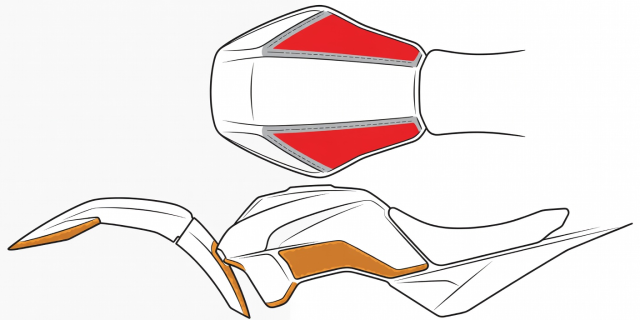
Mapping High-Abrasion Zones Early
If your riding posture presses knees firmly into the tank flanks or you use a magnetic tank bag, design your pinstripe borders so clear paint protection film (PPF) or rubber traction pads can sit neatly inside the coachline frame rather than cutting awkwardly across a graphic.
Flow-Coating to Bury Multi-Layer Graphics
When a scheme includes multiple masked colour blocks, metallic scallops, or vinyl decals, each layer adds a microscopic physical ridge. If only two standard coats of clear are applied over complex graphics, sunlight catching the tank at an angle will reveal a raised step along every stripe edge.
In custom show and road-durable paintwork, painters use an intermediate process called flow-coating (or inter-coat levelling): applying initial clear coats to lock down the graphics, allowing full cure, wet-sanding the surface completely flat so the raised stripe steps disappear into the clear thickness, and then spraying the final flow coats of topcoat. When budgeting time and materials with your paint shop, ask upfront whether your design calls for a single-stage clear session or a sanded flow-coat build.
Finish Comparison & Maintenance Matrix
| Finish System | Optical Depth & Contrast | Repairability & Road Care |
|---|---|---|
| Flow-Coated High Gloss 2K | Glass-smooth horizon reflection; zeroes out decal and pinstripe step edges; maximises pearl flop. | Light swirls and boot marks can be compounded and polished out over the life of the bike. |
| Eggshell / Satin Clear (25–40 GU) | Highlights the sculpted metal form of knee dents and sharp geometric masking lines without mirror glare. | Wash with pH-neutral soap devoid of waxes or silicone gloss enhancers; cannot be spot-polished. |
| Dead Matte Clear (<15 GU) | Velvety, stealthy surface that makes gloss pinstripes or gloss badges pop via pure sheen contrast. | Prone to burnishing (turning shiny) where rider knees rub repeatedly; strongly benefits from matte PPF on flanks. |
| Sacrificial Urethane Film (PPF) | Available in both optically clear gloss and matched stealth satin to preserve the underlying paint sheen. | Absorbs stone chips on front mudguards and jacket zipper scuffs on the rear tank belly; replaceable after years of use. |
Have a specific scenario in mind? Check Paintwork Decisions, Explained or send us a styling question.